Selecting Optimal Origami Scaffold Rotation
A second use of the scaffoldselector is to select the optimal scaffold strand rotation for small DNA origamis (e.g. up to 1000nt scaffold).
What is scaffold strand rotation?
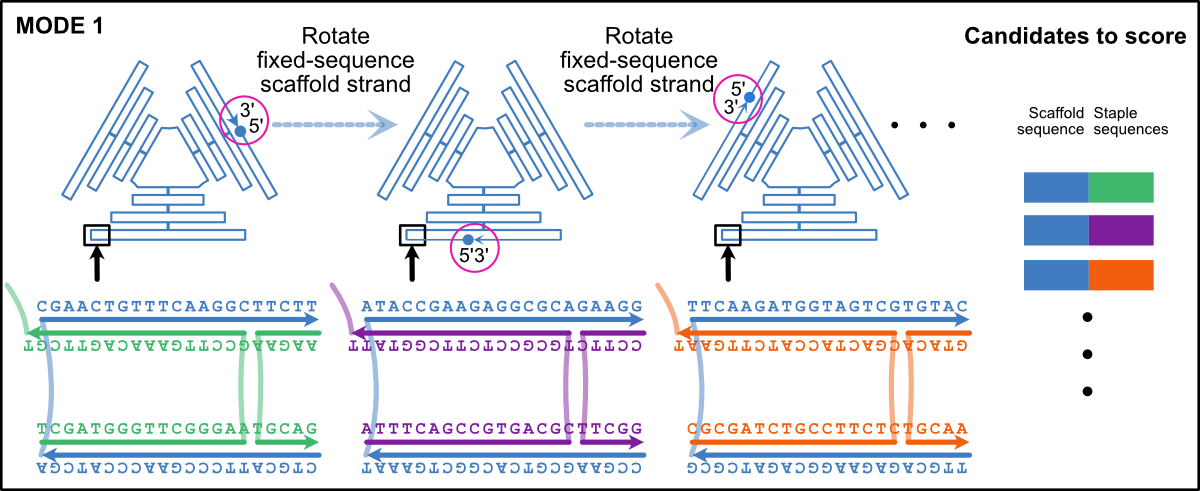
An origami with a fixed-sequence scaffold can still have it’s scaffold strand pinned into different positions within the structure by appropriate choice of staple sequences. In the below figure, the staple sequences are chosen to change the position of the 5’ and 3’ ends of the scaffold strand in a DNA origami triangle structure. The scaffoldselector scores a pool of origami sequence candidates which all have the same scaffold sequence, but which differ in their staple sequences (right panel on the figure).
Note on origami size
Scaffold strand rotation only yields significantly less staple-scaffold off-target binding sites (Metric 1) or scaffold-scaffold binding sites (Metric 2) if origami size is relatively small (e.g. up to 1000nt scaffold). Scaffold strand rotation should only be used with small origamis. In large 8000nt origamis, Metric 1 and Metric 2 scores stay almost constant at large values under scaffold strand rotation and hence sequence selection is not effective.
Worked Example: DNA Fourfinger Origami
Here we will again consider the fourfinger origami (as we did on page Selecting Origami Scaffold as Region of a Biological Vector Sequence). But here, we will assume it has a circular scaffold. This will allow us to score all 704 rotations of the scaffold strand.
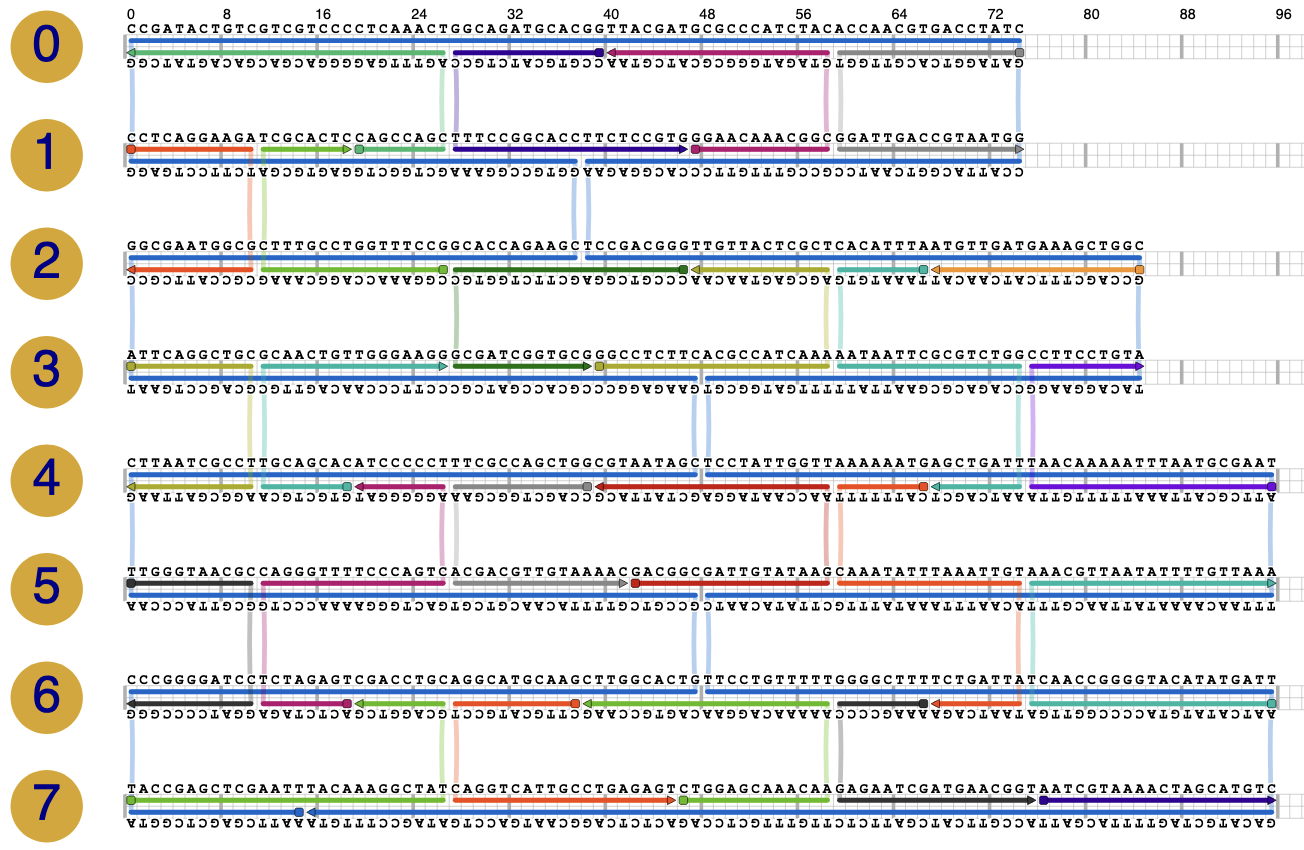
Origami scadnano design file
fourfinger.sc(Right click, Save As).Origami contact map, with scaffold circularised:
fourfinger-circ.csv(Right click, Save As).
We can score all rotations of the scaffold strand sequence by doing the following:
Move the contact map file to
origami/scaffoldselector/_input/fourfinger-circ.csv.Keep the default settings in the scaffold selector
settings.jsonfile:"mode 1 metrics" : "1,3,4", "scaffold material" : "DNA", "staple material" : "DNA"
Start scoring all rotations of the scaffold sequence of the fourfinger origami:
cd origami
source venv/bin/activate
cd scaffoldselector
python3 selector.py fourfinger-circ mode1
The program first outputs a summary of the sequence selection to be performed:
 ------------------------------------------------------------

 SCAFFOLD SELECTOR
 Multi-objective Scaffold Sequence Selection for DNA Origami

 ------------------------------------------------------------

SCORING
Origami : fourfinger-circ
Mode    : MODE 1 - Score all rotations of a fixed scaffold sequence

Loading settings.json...
[Done]
Making output directory...
[Done]
Loading origami contact map...
[Done]
Pre-computing energy models...
[Done]
Verifying origami contact map...
--> Warning: 1 staple sections binding to the scaffold are smaller than 7 nt.
The energy model can only detect binding sites 7 nt and above (with constants.MIN_BINDING_dG = -7.0 kcal/mol at 37C).
Off-target binding sites in Metric 1 and Metric 2 may be slightly under-estimated
[Success]
Calculating origami rotation number...
[Done]
Reading scaffold sequence pool...
[Done]
Building origami pool...
[Done]

Summary:
--> Origami 'fourfinger-circ' has a CIRCULAR 704 nt scaffold
--> There thus exist 704 rotations and all will be scored
--> Scoring with metrics [1, 3, 4]

Press Enter to start scoring, or q+Enter to quit...
Press Enter to begin. Execution time is around 10 minutes on a modern machine.
No Metric 2
The scaffold selector does not use Metric 2 (scaffold-scaffold binding sites) when scoring scaffold strand rotations. The scaffold sequence does not change over rotations.
When finished, check the HTML report of results at
scaffoldselector/_results/fourfinger-circ.html.
An example HTML report can be downloaded here: fourfinger-circ.zip (Right click, Save As).
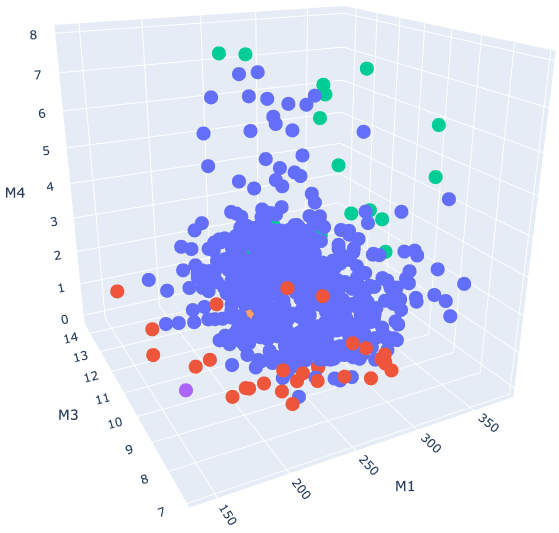
This results report shows that origami ID 653 is a good choice to implement the fourfinger origami. The scaffold strand in this origami has been rotated by 653 bases.
Origami ID 653 is ranked as the top-choice pareto candidate by all multi-criteria decision making schemes SAW, KNEE and TOPSIS (see our paper for explanations of these methods). It has the following scores for each metric:
Metric 1 |
Metric 3 |
Metric 4 |
|---|---|---|
152.92 |
8.65 |
1.15 |
-41.7% |
-16.3% |
-44.1% |
-34.4% |
-21.5% |
+8.5% |
(Note: Metric 2 score for all origamis is 153.61)
The first row of percentage scores signify that rotation 653 has:
41.7% less staple-scaffold off-target bindings (Metric 1) than the population mean
16.3% less staple-staple bindings (Metric 3) than the population mean
44.1% less intra-staple bindings (Metric 4) than the population mean
where “the population” refers to all 704 rotations of the scaffold.
The second row of percentage scores show the relative change from the original origami (with the scaffold not rotated) to origami ID 653.
The sequences of origami ID 653 can be downloaded via the FASTA link in the report (Or here: fourfinger-circ653_fasta.txt). The circular scaffold sequence remains unchanged, but the staple sequences are changed to pin the scaffold into new rotation 653.
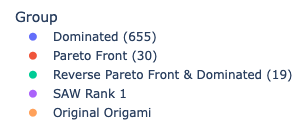
In the “Objective Space” section of the report, the position of the best-scoring origami with respect to the other 703 candidates is visualised (purple dot):
For interest, we can see that the worst rotation to implement the fourfinger origami would be origami ID 53. It has the following scores for each metric:
Metric 1 |
Metric 3 |
Metric 4 |
|---|---|---|
279.56 |
13.96 |
7.19 |
+6.5% |
+35.1% |
+251.0% |
(Note: Metric 2 score for all origamis is 153.61)
As could be expected for this origami, performing scaffold strand rotations of a fixed scaffold sequence gives much less variance in the metric scores than does changing the scaffold sequence itself (as we did in example Selecting Origami Scaffold as Region of a Biological Vector Sequence). However, off-target binding sites can still be reduced overall.
Requirements for Scaffold Strand Rotation
Not all origamis with a fixed-sequence scaffold strand can have the scaffold strand rotated. In general, an origami can have its scaffold strand rotated if:
The origami design does not contain any single base unhybridised regions on the scaffold strand and:
The scaffold strand is circular (in which case there are N valid rotations of the scaffold, if the scaffold strand has N nucleotides), or:
The scaffold strand is linear and the scaffold route forms a closed path. That is, the 3’ and 5’ of the scaffold are hybridised to adjacent bases of the same staple. The figure below clarifies this case. The rectangle origami in (a) can have it’s linear scaffold rotated, whereas the triangle in (b) cannot, since the 5’ and 3’ ends of the scaffold don’t form a closed path. The small holliday junction origami in (c) cannot have the scaffold rotated, again because the ends don’t form a closed path. Panel (d) shows that the triangle in (b) can have its scaffold rotated if the dangling ends of the scaffold are removed.

The scaffoldselector will check and report if an origami cannot have it’s scaffold strand rotated. In general, if an origami has a linear scaffold and it can be rotated, the number of valid rotation positions is less than the number of scaffold nucleotides. This is because moving the scaffold ends to some positions create very short (i.e. 5nt or below) hybridising domains on staples which are not allowed.